 郷
郷Regional Japan: Beyond the Big Cities (2026 Guide)
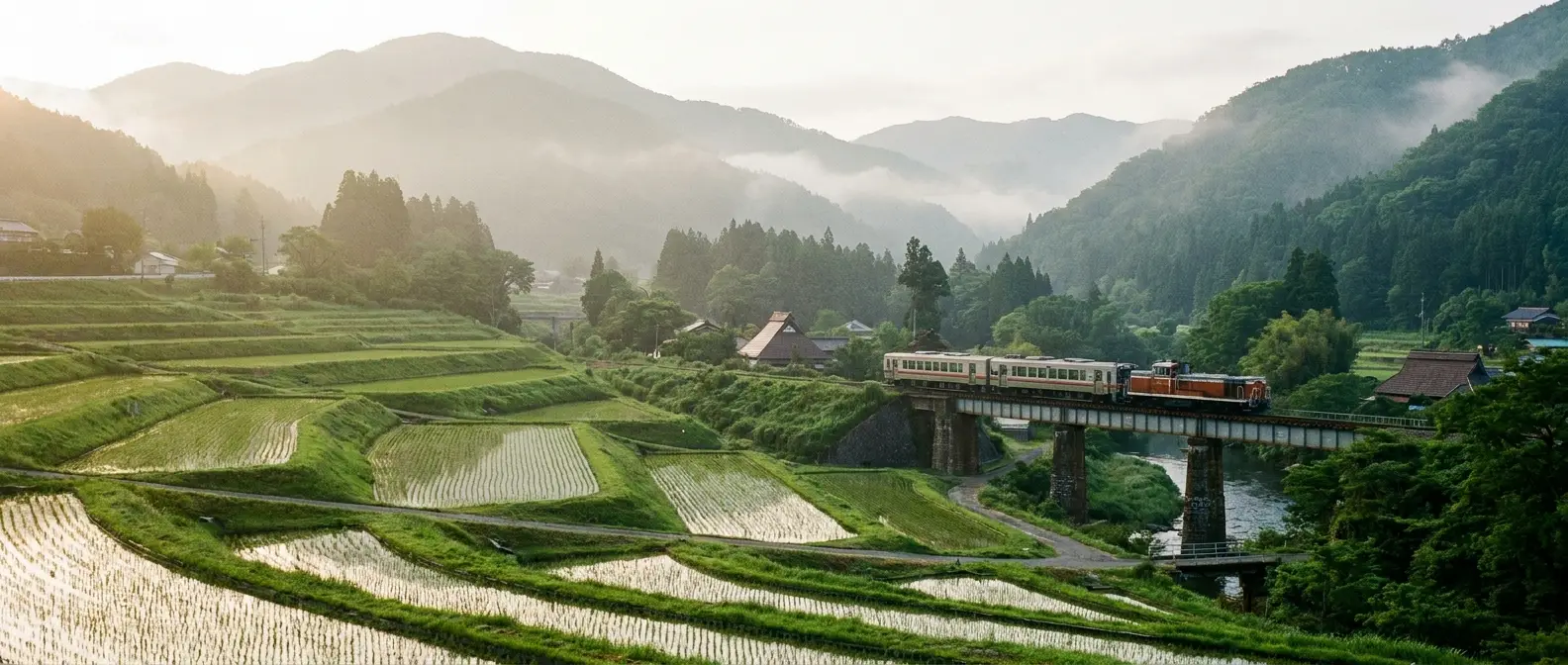
Most first trips to Japan run along the same line — Tokyo, Kyoto, Osaka — and for good reason. But those headline cities now carry the weight of the country's tourism, and at peak times it shows: crowded streets, queues, and rising local frustration. The quiet truth is that the best of Japan often lies just past the famous stops. Travel a little further and you trade crowds for space, and sightseeing for something closer to discovery.
Why go regional
Spreading out isn't only a kinder way to travel — it's frequently a better one. Regional Japan offers the same things people love about the country, with more room to enjoy them: living craft traditions, hot springs without the queues, distinct regional cuisines, and locals who are genuinely glad you came. Trains reach far more of the country than people expect, and a little planning opens it up.
You don't have to choose between famous and obscure. Anchor a trip on one or two big cities, then build in two or three nights somewhere regional — it's the single best change you can make to a standard itinerary.
The regions, in brief
Tohoku (northern Honshu) — Japan's deep north: mountains, samurai towns, remote hot springs, and some of the country's most spectacular autumn colour and winter snow. Long overlooked by foreign visitors, which is exactly its appeal.
The Japan Alps & Chubu (central Honshu) — soaring peaks, the preserved post towns of the old Nakasendo highway, the thatched-roof villages of the Shokawa valley, and castle towns. A region for walking, mountain scenery, and history.
Chugoku (western Honshu) — home to Hiroshima and its Peace Memorial, the floating shrine gate of Miyajima, and the art islands and gardens of the Seto Inland Sea. Accessible by shinkansen yet far quieter than the Kansai core.
Shikoku — the smallest of the four main islands, known for its 88-temple pilgrimage, dramatic river gorges, one of Japan's oldest hot springs, and a slow, rural rhythm that rewards unhurried travelers.
Kyushu — the southern island of volcanoes, hot-spring resorts, and a relaxed food culture, with Fukuoka as its gateway. See our Fukuoka guide.
Hokkaido — the northern frontier of wide landscapes, national parks, powder snow, and superb seafood and dairy, centred on Sapporo. See our Sapporo guide.
Okinawa — Japan's subtropical south: coral reefs, beaches, a distinct island culture and cuisine, and a climate all its own, a world away from the mainland.
How to actually do it
- Use the rail network. The shinkansen reaches far beyond the central corridor; regional and local lines do the rest. Our shinkansen guide and guide to Japan's trains explain how, and our JR Pass guide helps you decide whether a pass pays off for a longer, wider trip.
- Slow down. Regional travel works best at two or three nights per base, not one. Distances are real and the pleasure is in lingering.
- Eat local. Each region has its own specialities — seek them out rather than chain restaurants.
- Mind the seasons and holidays. Rural transport thins out, and domestic travel peaks during Japan's holiday weeks; see our Japanese holidays guide.
A simple approach
Pick one region to pair with your main cities. Flying into Sapporo or Fukuoka anchors a Hokkaido or Kyushu trip; a Chugoku loop adds Hiroshima and Miyajima to a Kansai stay; the Japan Alps slot neatly between Tokyo and Kyoto. One regional region, properly explored, often becomes the part of the trip people remember most.
FAQ
Is regional Japan hard to travel without a car? The main hubs and many famous sights are reachable by train and bus. A car helps for truly rural areas, but plenty of regions work car-free with a little planning.
Will I manage without much Japanese? In well-known regional towns, signage and basics are increasingly traveler-friendly. Further off the path, a translation app and a few polite phrases go a long way — and the welcome is warm.
Which region should a first-timer add? If you want easy access, Chugoku (Hiroshima and Miyajima). If you want a complete change of scene, Kyushu or Hokkaido, each built around a gateway city.
Related: Sapporo · Fukuoka · The shinkansen · All destinations